Fylo
Co-built an explainable routing and review system for small support teams.
- Field
- Applied AI product
- Role
- Product engineer and backend implementer
The product
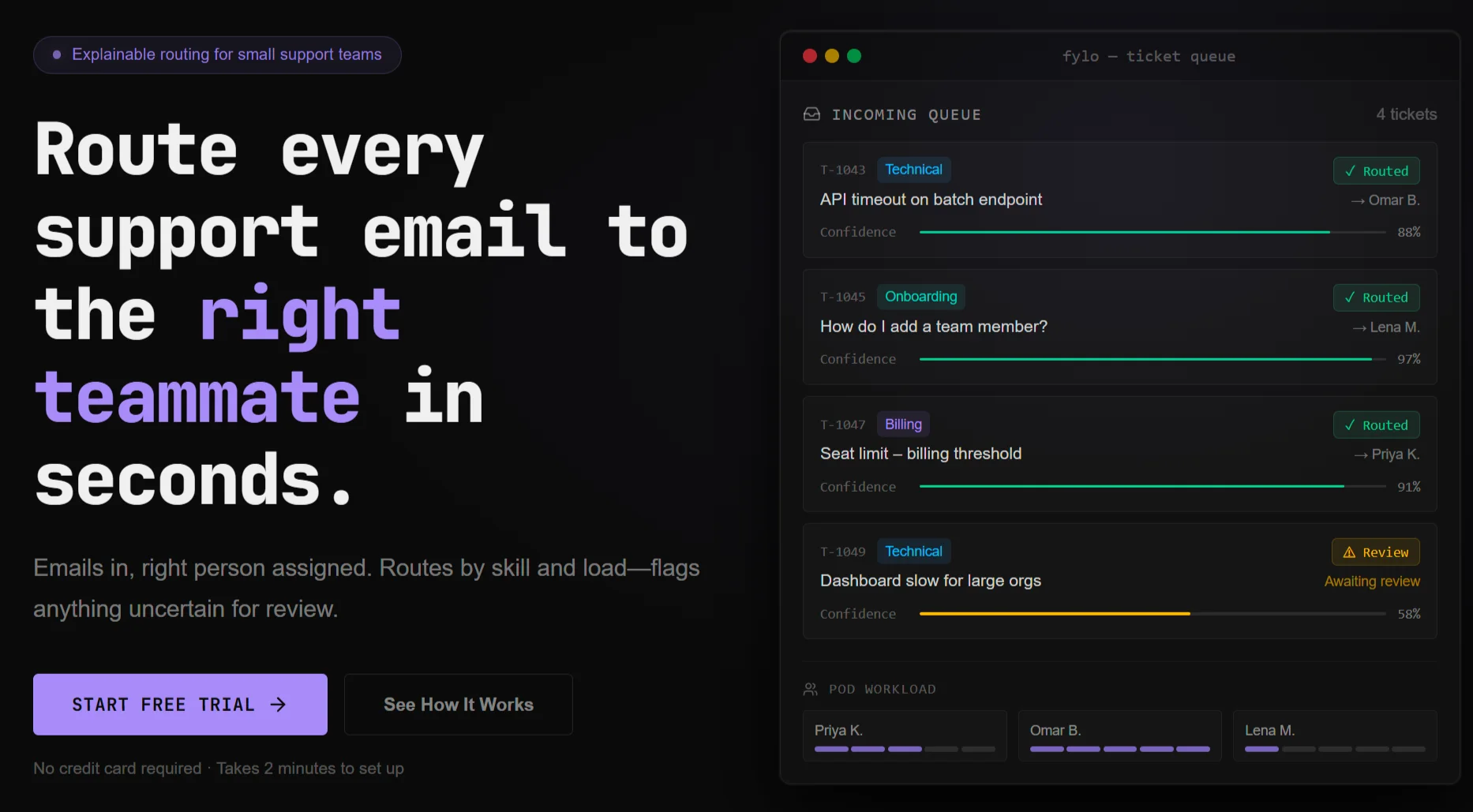
Small support teams often route work by manually reading a shared inbox and deciding who should take each request. Fylo turns that process into an operating workflow: it structures incoming email, classifies the request, evaluates the available teammates, and either assigns the ticket or sends it to review.
The project was built for Developer Camp’s Future of Work track. I co-built it with Kean Louis Rosales, Vincent Ferrer, and Miguel Kalaw.
My contribution
I implemented authentication, inbound ticket ingestion, agent profiles, routing, draft persistence, and the connections between those parts of the product workflow.
The queue, review, workload, policy, and ticket views use the same ticket and routing data.
How routing works
An inbound email becomes a structured ticket with an intent, urgency, sentiment, and confidence score. The routing engine then evaluates eligible teammates against three practical signals:
- whether their skills match the request;
- how much work they already hold;
- whether the assignment clears the workspace’s confidence policy.
The resulting recommendation includes a readable reason. A lead can see why someone was selected instead of treating the model as a hidden assignment rule.
Human review
Fylo does not force every request through automation. Clear assignments enter the live queue. Lower-confidence cases move to review, where a person can inspect the ticket, change the decision, add notes, and approve or revise a drafted reply.
The workspace confidence policy determines when a recommendation can enter the queue and when it needs another check.
The implemented workflow
- authenticated and protected product routes;
- validated, idempotent inbound email ingestion;
- Gemini-backed classification, drafting, and resume parsing;
- deterministic fallback metadata when a provider is unavailable;
- skill- and workload-aware routing;
- live queue, review, workload, policy, and ticket views;
- notes, lead review actions, and approved outbound replies;
- unit, integration, and browser coverage for the core flow.
Current scope
The core routing and review workflow is implemented. Workspace and membership administration still needs a complete interface, and a true provider-to-application inbound email test depends on a configured live environment.