Qu-Alz
Co-built a research system exploring earlier Alzheimer’s risk assessment through brain MRI, machine learning, and quantum methods.
- Field
- Applied quantum research
- Role
- Research engineer and co-author
- Recognition
- SEA Quantathon 1st runner-up · ASEAN IVO Forum presentation
The project
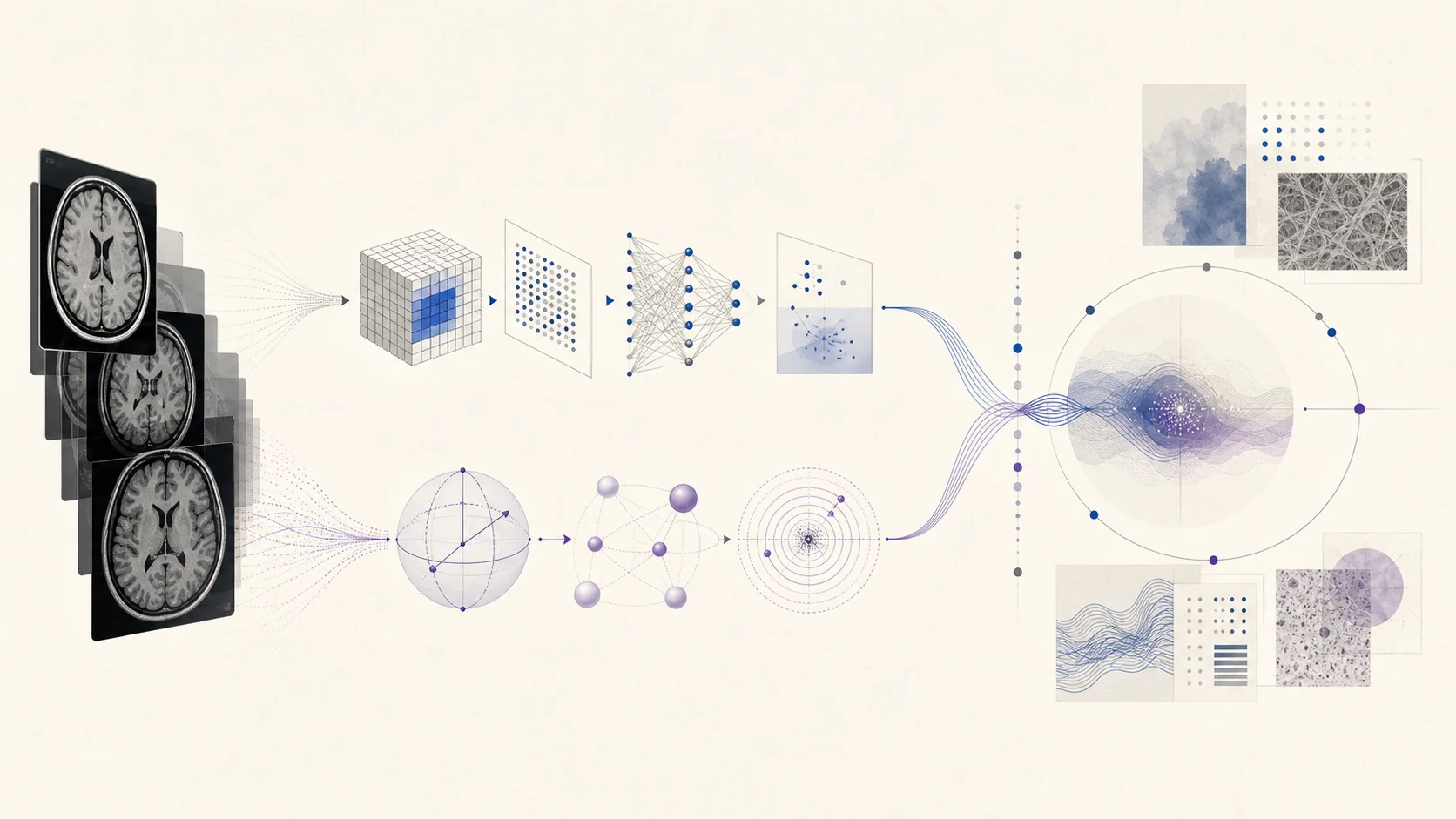
Qu-Alz began with a research question: could MRI-based stage classification be paired with a quantum-derived signal to support earlier assessment of Alzheimer’s risk?
We investigated that question through a research prototype.
I developed Qu-Alz with Sayed Tahlil Hossain, Dimas Sakti Widyatmaja, and Mutawally Nawwar. We built a working research system that combined medical-image processing, machine learning, quantum computation, and an interface for reviewing the outputs together.
My role
I worked across the research implementation and co-authored the conference paper.
The system connected four pieces:
- MRI preprocessing and brain-region segmentation with PyTorch models;
- classification across four stages of cognitive impairment;
- an Entanglement Entropy Score derived from quantum-encoded image features;
- a research interface for reviewing the model outputs together.
The quantum path
MRI-derived features were encoded with a ZZFeatureMap, reduced density matrices were computed, and von Neumann entropy produced the Entanglement Entropy Score. The score was then considered alongside the segmentation and stage-classification outputs in the combined research workflow.
From competition work to presented work
We first developed Qu-Alz for SEA Quantathon 2025, where it placed 1st runner-up. We then developed the work into a conference paper, which was accepted for presentation at ASEAN IVO Forum 2025 as “Qu-Alz: Quantum-Enhanced Early Prediction of Alzheimer’s in Southeast Asia.”