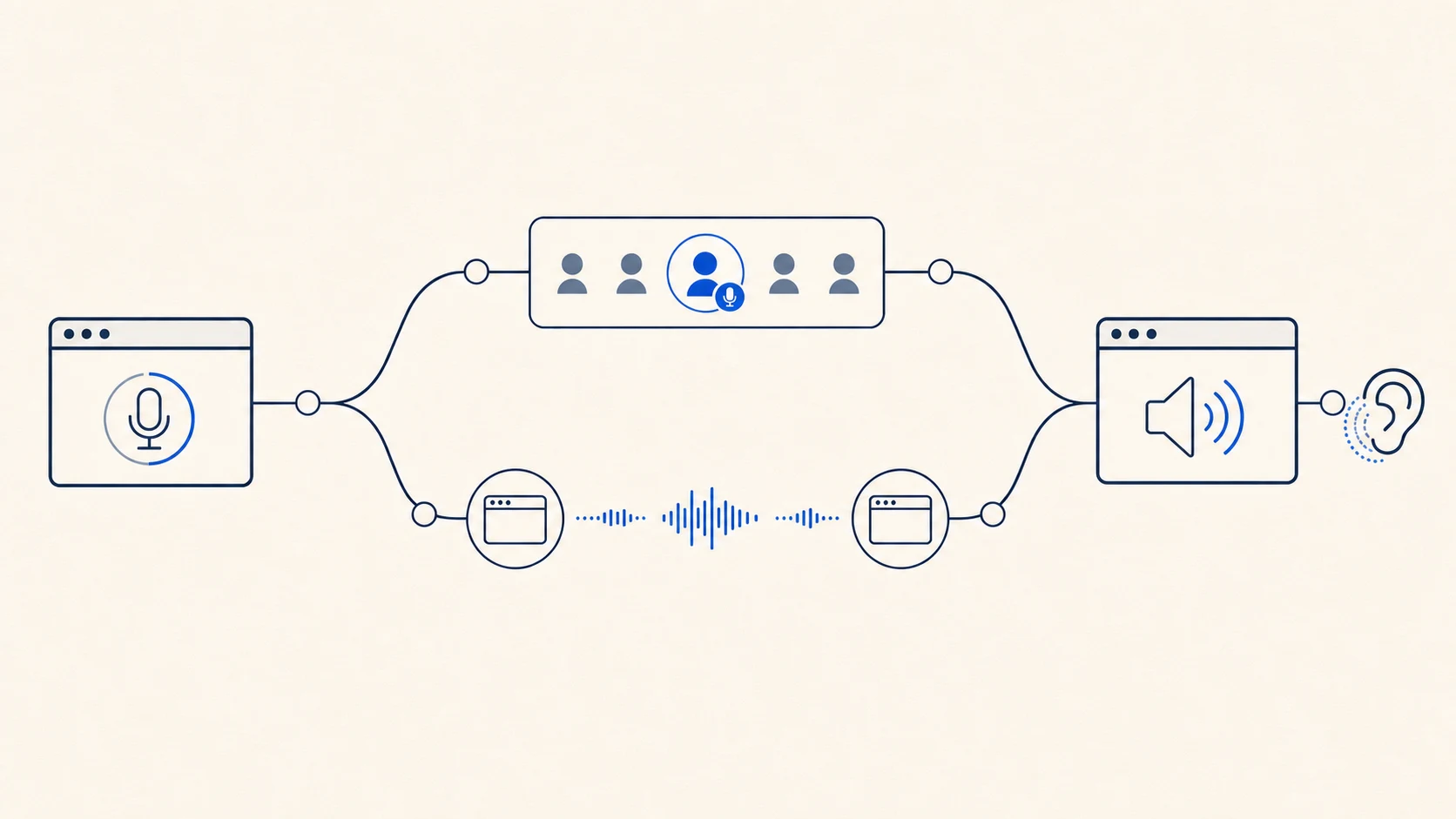
When I started implementing a browser-based push-to-talk proof of concept, I thought success would be easy to recognize: press a button in one browser and hear speech in another.
The project soon exposed how many different failures could produce the same silence. The sender might lack microphone permission. The control service might deny the floor. Signaling could complete without producing a usable network path. Packets could flow while the receiving browser refused to play them.
The reverse was also possible. Every visible status could look healthy while the listener heard nothing.
I eventually stopped asking whether the demo worked and began asking which part had worked, under what conditions, and how I knew.
One workflow, several tests
The application combined a dispatcher, browser endpoints, room membership, push-to-talk floor control, status updates, emergency signaling, location summaries, audio, and video. Together, they made one product workflow. Testing them as one undifferentiated feature would have hidden most of the useful information.
Interface tests covered visible state and user actions. Service tests checked room behavior and floor ownership. WebRTC statistics described peer connections and packet flow. Physical listening covered the final path through the browser and receiving device. Each method answered a different question.
This distinction mattered during debugging. In one failure, signaling completed but no usable media path formed. In another, the peer connection and outbound statistics looked healthy, yet the receiver remained silent. A user would describe either case as “PTT failed,” but they pointed to different parts of the system.
It also affected the architecture. I kept room state, presence, floor ownership, and signaling in the control path, while live audio and video traveled through the media path. Results from the two paths remained separate unless a test deliberately connected them.
Writing the question before the test
The feature was too broad to be a useful unit of work. Joining a room, receiving the floor, reaching the intended peer, forming a media connection, attaching an incoming track, beginning playback, hearing speech, preserving intelligibility, and testing control-service behavior with simulated clients were separate questions. Answering one could not stand in for the others.
I chose a check for each one:
| Question | How I checked it | What it did not cover |
|---|---|---|
| Room and floor-control behavior | Deterministic service tests and event assertions | Did not cover audio delivery |
| Browser workflow | Automated interaction and state checks | Did not cover physical microphone, speaker, or permission behavior |
| Media establishment | Peer, network-path, and packet statistics | Did not establish human audibility |
| Receiver audibility | Physical browser and device observation | Applied only to the tested setup |
| Audio quality | Fixed reference speech, receiving-end capture, objective indicators, and blinded listening | Was not population-level evaluation or production certification |
| Logical endpoint load | Simulated control-plane load tests | Did not measure live-media capacity |
The test runs needed structure. Each one recorded its scenario, participants, environment, network condition, events, assertions, metrics, and known limitations. A pass, failure, or incomplete observation had a different meaning, so the tooling kept them distinct.
Detailed logs, screenshots, raw media, and run-specific diagnostics stayed in private storage. Reports carried only the relevant results, while validation code caught unsafe paths, missing privacy metadata, malformed metrics, and conclusions that exceeded the test behind them.
Failures stayed in the record as well. A clean retry did not erase an earlier run with stale receiver state, a missing media path, an extra playback action, or an ineligible measurement. Browser media can recover after a retry without explaining what went wrong; retaining the failed run made that difference visible.
Where automation stopped
Software could reliably exercise room transitions, floor grants and denials, disconnect cleanup, signaling, peer states, browser statistics, interface regressions, result validation, simulated control-plane load, and protocol-support experiments. I automated those parts.
Microphone permission, receiver output, camera behavior, autoplay restrictions, network switching, and human listening still needed physical checks. Automation prepared the participants, established the intended state, and collected diagnostics before the operator performed the action or judgment that software could not supply.
Audio quality made the difference particularly clear. Hearing speech once established audibility for that setup. It said little about how much the signal had changed.
To examine that question, I used fixed, licensed reference speech and captured the receiving-end decoded track before speaker playback. Comparing the source with that capture avoided adding room acoustics, microphone placement, and speaker characteristics to the measurement.
Objective intelligibility indicators covered eligible source and received pairs. Randomized, blinded listening trials tested whether listeners could detect a difference. Physical browser checks then covered the output path that decoded-track analysis could not observe.
The campaign supported two limited findings: speech was audible in the tested setup, and the received signal differed detectably from the source. That gave the next phase a concrete quality target without treating those results as a general conclusion that the audio was “good.”
Measurements had to match the decision
The same rule shaped the technical comparison. Some approaches could run through the browser product path. Others belonged in supporting experiments. Options that required a native client, hardware integration, or another server stack could only be studied through documentation at this stage.
I kept five levels of implementation visible:
- Implemented and measured in the product workflow.
- Implemented in a supporting experiment.
- Observed as browser or platform capability.
- Researched as a possible integration path.
- Unavailable without additional inputs.
A small capability probe remained separate from the live-media implementation. The browser-native media path served as the PoC baseline because it matched the immediate workflow. Relay and media-server approaches remained relevant to reliability and fanout, while control-oriented and hardware-oriented paths raised different platform and timing questions. The recommendation was conditional on what had been tested at this stage.
Load testing required similar care. Synthetic clients exercised membership, presence, heartbeats, floor requests, denials, releases, and event fanout. These runs described control-service behavior under a defined simulated-client profile.
They said nothing about the number of simultaneous live audio or video streams a production system could support. That question depends on bitrate, devices, network conditions, media topology, and whether traffic travels peer to peer, through a relay, or through a forwarding server. A control-plane result could not supply a defensible media-capacity number.
What remained after the PoC
By the end of the work, the browser workflow had structured tests, physical observations, repeatable diagnostics, and recorded limitations. It was still a proof of concept.
Those results narrowed the next set of engineering questions to receiver recovery, media quality, network fallback, larger-room topology, operational visibility, and product hardening. Browser push-to-talk was no longer one large unknown.
I now begin PoC work by writing down what I need to learn, how I can test it, and which questions a successful result would leave open.